
 Login
Login 

Compliance, Fatigue & Safety
How to Check a Contractor Licence, White Card or High Risk Work Ticket
By Christian Tietzel · 24 August 2026 · Updated 28 September 2026

To check a White Card, contractor licence or high risk work ticket in Australia, go to the state or territory that issued it, because no national register covers them. NSW, Victoria and WA run online White Card checks. In Queensland and South Australia the training organisation issues the card, so that is who to ask.
Anyone can buy a hi-vis vest. Plenty of people can produce a plausible-looking card. What separates a compliant crew from an expensive incident report is whether somebody actually checked the credentials against the registers that issue them, and wrote the check down.
That’s not a hypothetical risk. When the Queensland Building and Construction Commission audited more than 700 building sites in a month-long crackdown in October 2024, it caught 58 people suspected of illegal building work, 40 suspected unlicensed workers and 18 licensees suspected of engaging them. One month, one state.
This is the reference we wished existed the last time we went looking. Where to verify each type of credential, state by state, what the registers genuinely can’t tell you, and how to record a check so it still protects you in an audit two years later. Bookmark it, because the registers move around and we keep the links current.
One orientation note first. “Checking a licence” means three different checks that get blurred into one, and they run through entirely different systems.
- The business. Is this contracting entity real, registered and licensed to take the work?
- The card. Does this person hold general construction induction, the White Card?
- The ticket. Does this person hold the high risk work licence class the task needs?
Do them in that order. A perfectly licensed operator working through a deregistered entity is still a problem you own. And verification is step two of a wider job: what to collect in the first place, insurances and SWMS included, is covered in the subcontractor onboarding checklist.
Start with the entity, not the person
Before any trade register, spend two minutes on the business itself. ABN Lookup confirms the ABN is active, who holds it, and whether they’re registered for GST. It also exposes the classic trap. The name on the ute is a trading name, the licence is held under a legal entity name, and the two don’t obviously match. Search both, and keep the legal entity name for every register search that follows.
If the entity checks out, move to the licence their trade requires.
Contractor and trade licence registers, state by state
Building and trade licensing is state-based, so the register depends on where the work happens, not where the contractor lives. These are the public search points.
| State | Register | Where to search |
|---|---|---|
| NSW | Trade and contractor licences | Service NSW licence verification |
| VIC | Registered building practitioners | VBA practitioner search |
| QLD | Building and construction licensees | QBCC licensee search |
| WA | Building service practitioners and contractors | Building Services registers via DEMIRS |
| SA | Licensed trades and occupations | Consumer and Business Services licence search |
| TAS | Licensed occupations | CBOS occupational licence search |
| ACT | Licensed trades | Access Canberra public registers |
| NT | Occupational licences | NT Government licensing |
Search by the legal entity name and by the individual’s name, because some states license the entity, some the individual, and some both. Check the licence class covers the scope of your work, not just the trade. A builder licensed for residential work isn’t licensed for your commercial fit-out because the register returned a green tick.
If the crew arrives through a labour hire provider rather than a direct engagement, there’s a fourth check that isn’t optional in the licensed states. Victoria’s Labour Hire Authority register and the Queensland labour hire licensing register both let you confirm the provider holds a current licence, and hosts in those states commit an offence by using an unlicensed provider. SA and the ACT run schemes too, searchable through the same state licensing bodies above. The full host-side picture, registers, current penalties and the 2026 South Australian expansion included, is in our guide to labour hire host employer obligations.
How to check a White Card, state by state
The White Card, formally the general construction induction card, has no national register. Each state and territory runs its own arrangement, and the first thing to establish is who issued the card, because in Queensland, WA and South Australia that is the training organisation (RTO) and not the regulator. Every row below comes from the regulator’s or issuing agency’s own page, read on 28 September 2026.
If the White Card is the only credential on today’s list, the dedicated White Card check guide takes each state in turn, for the employer running the check and for the worker chasing their own card number.
| State | Who issues the card | Where an employer can check it |
|---|---|---|
| NSW | SafeWork NSW, on an application the RTO lodges | Verify NSW’s white card register, searched by card holder name or card number |
| VIC | WorkSafe Victoria, on an application the RTO lodges | WorkSafe Victoria’s licence and construction induction card search, which asks for the card number and the holder’s surname |
| QLD | The RTO that ran the training | No lookup on the regulator’s page. Ask the RTO named on the card, which WorkSafe Queensland says issues and replaces it |
| WA | The RTO that ran the training | WorkSafe WA’s construction induction training card database, searched by card number, or by the holder’s name and date of birth |
| SA | The RTO that ran the training | No lookup on the regulator’s page. Ask the issuing RTO, because SafeWork SA neither issues nor replaces White Cards |
| TAS | WorkSafe Tasmania, on an application lodged at Service Tasmania | No lookup on the regulator’s page. Ask WorkSafe Tasmania |
| ACT | Access Canberra, on behalf of the WorkSafe ACT Commissioner | No lookup on the agency’s page. Ask Access Canberra’s construction licensing team |
| NT | The Territory Business Centre, on application after training | Digital cards, introduced on 1 June 2022, carry a QR code an employer can scan, according to NT WorkSafe. For a physical card, ask NT WorkSafe |
Two cautions on reading that table. Where it says no lookup, it means exactly that: the page mentions none, which isn’t proof that nothing exists, so ask before you assume. And a register hit confirms the card and the name on it, not that the person at the gate is that person. Sight the physical or digital card, match the name to photo ID, and check the issuing state and RTO details look coherent. Treat a card with no RTO number, odd fonts or laminated-at-home energy as exactly what it appears to be.
NSW and the NT both offer a digital White Card. NT WorkSafe still encourages workers to carry the physical one, because a digital card may not be accessible or verifiable on a site that bans phones or has no reception.
Two genuine rules worth knowing. A White Card from any state is valid nationally, so a Queensland card on a WA site is fine. And a card doesn’t expire on paper, but most regulators treat it as lapsed if the holder has been out of construction work for two years or more. Asking “when did you last work on the tools” is a legitimate part of the check.
How to find a White Card number
The number is printed on the card. If the card is lost, NSW holders can find their details through Service NSW’s White Card check, and WorkSafe WA’s database shows a holder’s card details and the name of the RTO that issued the card. Elsewhere, start with whoever issued it, which in Queensland and South Australia is the RTO that ran the course. SafeWork SA’s advice for anyone who can’t remember the provider is the USI transcript, which shows where the training was done if it was completed after 1 January 2015. WorkSafe Tasmania’s advice is simpler: photograph the number the day the card arrives.
For an employer the number is the search key. Record it at onboarding with the issuing state and the RTO number, and the check can be re-run later without the worker in the room.
High risk work licences
High risk work licences cover the nationally defined classes, forklifts, specific crane types, elevating work platforms with a boom of 11 metres or more, dogging and rigging, and the rest. They’re issued by each state’s WHS regulator against national standards, and a licence from one state is valid in all of them. Safe Work Australia maintains the framework, while the state regulators run licensing and their own verification services, like the NSW check built into Service NSW’s verify tool or the regulator lookups run by WorkSafe WA and WorkSafe Queensland.
The check that matters is class against task. HRW licences are issued per class, and the class codes are specific. A CN licence doesn’t cover a slewing crane over 100 tonnes. A forklift LF doesn’t cover an order picker LO. The register will happily confirm a licence is current while the class printed on it has nothing to do with the machine you’re about to hand over. Match the code to the work, every time.
And remember what the licence doesn’t prove. Plenty of high-consequence plant, excavators, loaders, dump trucks, needs no HRW licence at all. For that equipment, competency is demonstrated through training records and a current verification of competency, which most major sites now demand per machine type regardless of what tickets an operator holds.
A worked example, end to end
Say you’re a Brisbane civil contractor bringing on a subbie electrician for switchboard work, and their crew includes an EWP operator. Hypothetical names, real process.
First the entity. ABN Lookup on the name from the quote, which turns out to be a trading name for a Pty Ltd. Active ABN, GST registered, legal entity name captured. Two minutes.
Second the trade licence. Electrical work in Queensland means an electrical contractor licence for the business, so the entity name goes through the state’s licensing search, and the class and expiry get recorded. The individual sparky’s electrical work licence gets the same treatment. Five minutes, mostly finding the right spelling.
Third the site basics. Both workers produce White Cards, sighted against photo ID. One is a 2011 cardboard card from another state, still valid on its face, so the follow-up question is recency of construction work, answered convincingly. Noted anyway. The other is a Queensland card, which the RTO issues, so the RTO’s name and number go on the record in case the card ever needs confirming.
Fourth the ticket. The EWP in the plan has a 13-metre boom, which puts it in high risk work territory. The operator’s WP class licence gets verified through the issuing state’s check, class code matched to the actual machine, expiry recorded. The boom size is the detail that made this check mandatory rather than optional, and it’s exactly the kind of detail a generic checklist misses.
Total, maybe 15 minutes. The value isn’t the 15 minutes. It’s that all four results now sit against the subbie’s record with expiry dates attached, so the next job with this crew starts from evidence rather than optimism.
What the registers can’t tell you
A register hit is necessary and radically insufficient. Five things no public register will surface.
- Scope mismatch. Licensed, but not for that class of work, that machine or that contract value
- Currency cliffs. Current today, expiring the week your job peaks. Registers show status, not your schedule
- Insurance. Public liability and workers comp certificates of currency sit outside licensing entirely and expire on their own clock
- Site access. No register knows whether the worker holds your client’s induction or medical
- The person in front of you. A register confirms a licence exists, not that the bloke holding the phone is its owner. Photo ID closes that loop
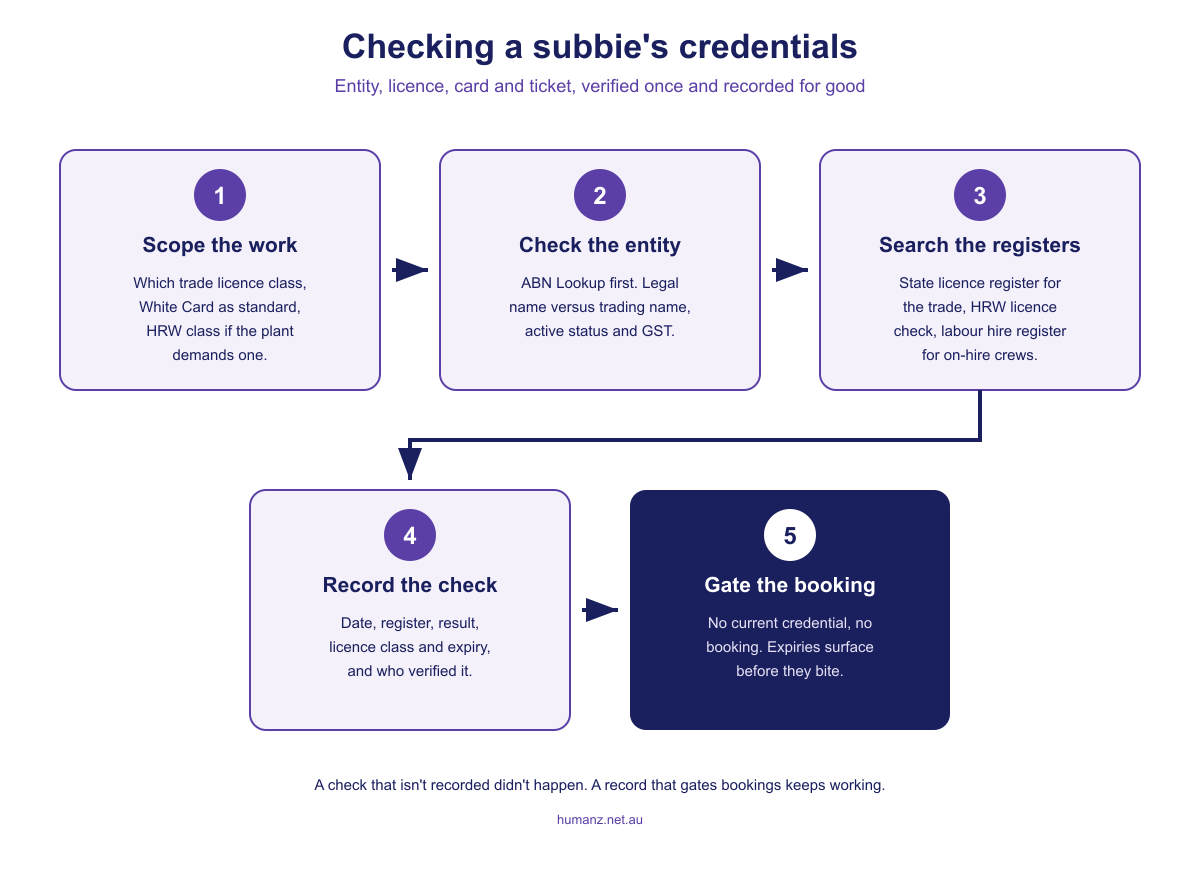
A check that isn’t recorded didn’t happen
Here’s the part that decides whether all of the above was worth doing. What protects you isn’t having checked. It’s being able to show you checked. For high risk work the law says so in as many words: in Queensland, section 85 of the Work Health and Safety Regulation 2011 stops a business putting a worker on licensed high risk work until it has seen written evidence of the licence, and requires a record of that evidence to be kept for at least a year after the work is carried out. Whatever the credential, capture the date, the register, the result, who ran it, and the expiry that triggers the next check.
A screenshot dropped into an email thread technically meets that bar and practically fails it, because nobody can find it in 18 months. The workable pattern is a credential record against each worker and each contracting entity, with the verification evidence attached and the expiry dates driving alerts. That’s the model our subcontractor management software runs. Credentials, insurances and licence checks live on the profile, expiries surface before they bite, and the roster refuses to book anyone onto work their verified credentials don’t cover. The register check happens once, properly, and then keeps working.
For the broader system around this, our guide to qualification and induction tracking covers how credentials, inductions and medicals stay current across a whole workforce, and the subcontractor onboarding process piece covers the wider document set beyond licences.
The registers above will drift. Agencies rebrand, URLs move, states merge portals. We re-check every link in this article on a schedule, so if one has rotted since you bookmarked this page, the register’s name in the table will still get you there through a search engine in under a minute.
Frequently asked questions
Can you check a White Card online in Australia?
Yes in NSW, Victoria and WA, though not through a national register, because none exists. NSW cards can be checked on the Verify NSW register by name or card number, Victorian cards through WorkSafe Victoria’s licence and construction induction card search, and WA cards through WorkSafe WA’s card database. In Queensland and South Australia the training organisation issues the card, so that is who to ask. Whatever the state, match the card to photo ID.
How do I find my White Card number?
The White Card number is printed on the card itself. If the card is lost, NSW holders can find their details through the Service NSW White Card check, and WA holders through WorkSafe WA’s card database. Elsewhere, contact whoever issued the card, which in Queensland and South Australia is the registered training organisation that ran the course. A USI transcript shows where the training was done if it was completed after 1 January 2015.
Can you look up a White Card by name?
Yes in NSW and WA. The Verify NSW register accepts a card holder’s name or a card number, and WA’s online search asks for the holder’s first name, family name and date of birth. Victoria’s search asks for the card number and the holder’s surname. The regulators in the other states and territories list no public search, so the card is confirmed with whoever issued it.
Does a White Card expire?
No, a White Card carries no expiry date on paper. Most regulators treat it as lapsed, though, if the holder has been out of construction work for two years or more. So a 2011 card can still be valid, provided the holder has stayed on the tools, and asking when they last did construction work is a legitimate part of the check.
Is there a national register for contractor licences?
No. Building and trade licensing is state and territory based, so the search runs through the register where the work is performed, such as Service NSW, the VBA in Victoria or the QBCC in Queensland. High risk work licences are the partial exception, issued by states against national classes and valid everywhere.
What should be recorded when verifying a licence?
The date of the check, the register searched, the exact name searched, the result, the licence number and class, its expiry, and who performed the verification. Keep the evidence, a saved extract or screenshot, against the worker or entity it belongs to, so an auditor two years later gets an answer in minutes rather than a reconstruction.
How often should contractor licences be re-checked?
At engagement, then on a cycle matched to risk, with annual re-verification a sensible floor for ongoing arrangements. Set alerts on every expiry date you capture, licences, insurances and inductions alike, because the register won’t ring you when something lapses mid-project.
Do labour hire providers need a licence check as well?
Yes, in the states that run labour hire licensing schemes. Victoria and Queensland both maintain public registers of licensed providers, and hosts in those states commit an offence by using an unlicensed one. South Australia and the ACT run schemes too. Check the provider’s licence before you start on the individual tickets of the crew they send.
Does a licence check cover insurance as well?
No. Licensing registers say nothing about public liability or workers compensation, which are separate documents with their own expiry dates. Request certificates of currency directly, check the insured entity name matches the contracting entity, and diarise the expiries alongside the licence dates.
Related articles
Ready to see Humanz on your own roster?
Free 30-minute walkthrough, we'll use your real crews, sites and shift patterns.