
 Login
Login 

Rostering & Scheduling
Shift swaps: how to run them without the group chat
By Duane Butler · 10 August 2026 · Updated 5 October 2026

A shift swap is a worker-to-worker trade of a rostered shift, where a workmate takes the shift you can’t make. On an Australian crew it has to pass the same checks as the original roster did: the incoming worker’s tickets and site induction, the minimum break between shifts under their award, and an hours record Fair Work can rely on.
The traditional shift swap protocol is a bloke yelling across the crib room, followed by a text to the supervisor, followed by nothing at all. The roster still shows the original names. Payroll pays the wrong people. And when someone asks, three weeks later, who actually worked the Saturday night shift, the answer lives in a deleted group chat.
Shift swapping itself is healthy. A workforce that can trade shifts covers its own gaps, keeps casuals engaged and saves coordinators hours of backfilling. The problem is that most businesses have no system for it, so every swap is a small, silent compliance bet. This guide covers what counts as a swap, how to swap a shift so it sticks, the checks that matter under Australian awards and WHS rules, and what a shift swap app should do inside rostering software built for field teams.
What a shift swap is, and what it isn’t
Three different things get called a swap on site, and each needs different handling.
A shift swap is worker-to-worker. Someone can’t make a shift they own, and a specific workmate takes it. Strictly that’s a two-way trade (your Saturday for my Tuesday), but on most crews the word covers the one-way handover too. The trigger comes from the crew, and the system’s job is to check the incoming worker and keep the record straight.
An open shift is coordinator-to-many. A gap needs filling, and the shift is broadcast to every eligible worker at once, first-in or coordinator’s pick. On a blended crew the eligible pool includes subbies carried on the same roster as your employees, so a gap doesn’t stop dead at the payroll boundary.
Cover is what happens when neither was arranged in time: a 5am sick call, and a coordinator finding a body for a shift that starts in two hours. It’s an open shift under pressure, and it’s where unqualified or under-rested workers most often end up on site.
Run all three through the same gates and the only real difference is who starts the conversation and how much time they have.
Why group-chat swaps go wrong
A swap agreed between two workers looks harmless. Here’s what it quietly bypasses.
Nobody checks the incoming worker’s tickets. The original roster put a person with the right licence, induction and site access on that shift. The mate who takes it over might have none of the three. On a construction site or mine, that’s not an admin slip. It’s an unqualified worker in a hazardous environment, and the business carries the liability.
Nobody checks hours and breaks. The incoming worker might be finishing a close and opening the next morning (the classic clopen), blowing through the 10-hour minimum break their award requires between shifts. Or they might be on their sixth consecutive day, or already near a rolling-hours limit. None of that is visible in a chat thread.
The roster stops being true. Once reality diverges from the system, everything downstream inherits the error: timesheets prefilled with the wrong name, payroll paying the person who didn’t work, and site records that show the wrong crew during an incident window.
There’s no record. Time and wages records must show who actually worked, and the Fair Work Ombudsman’s record-keeping rules expect those records to be accurate and retrievable for seven years. “Davo covered it, I think” is not a record. The Ombudsman handed out 743 infringement notices for record-keeping or pay slip breaches in 2024-25, with $838,000 in penalties paid, and a swap that lives in a deleted group chat is the kind of gap those notices land on.
A useful test of your current process: if WorkSafe or a client auditor asked who worked a specific shift two months ago, and whether they were qualified and adequately rested, how long would the answer take? If the honest answer is “we’d reconstruct it from texts,” the process is the problem.
How to swap a shift
If you’re the worker asking “can I swap my shift?” rather than the coordinator running the roster, this is the version that sticks, app or whiteboard.
- Agree it with your workmate. Find someone who actually wants the shift, not someone who’ll say yes at smoko and forget by knock-off. Settle whether it’s a straight trade or a one-way handover, and which dates.
- Check you both hold what the shift needs, and have the rest gap. The shift might call for a ticket or site induction the other person doesn’t hold, and if they knock off late the night before, the minimum break their award sets between shifts (commonly 10 or 12 hours) may not fit. If either check fails the swap won’t be approved, so save everyone the paperwork.
- Put the request in the app, or to the coordinator. A swap agreed in the crib room isn’t a swap. In a shift swap app, or a rostering app that handles swaps, it’s a request against the actual shift, naming both workers; without one, it’s a message to the coordinator with the same details, in writing.
- Wait for approval. Until the coordinator signs off, the original roster stands and the original name is responsible for turning up. Silence is not a yes.
- Confirm the updated roster. Once it’s approved, both of you check the roster shows the new names. That roster is what payroll and the site record follow, so if it’s wrong there, it’s wrong everywhere.
What a compliant swap looks like
That’s the worker’s side. On the system side, the swap must end as a roster change that passed the same gates as the original booking.
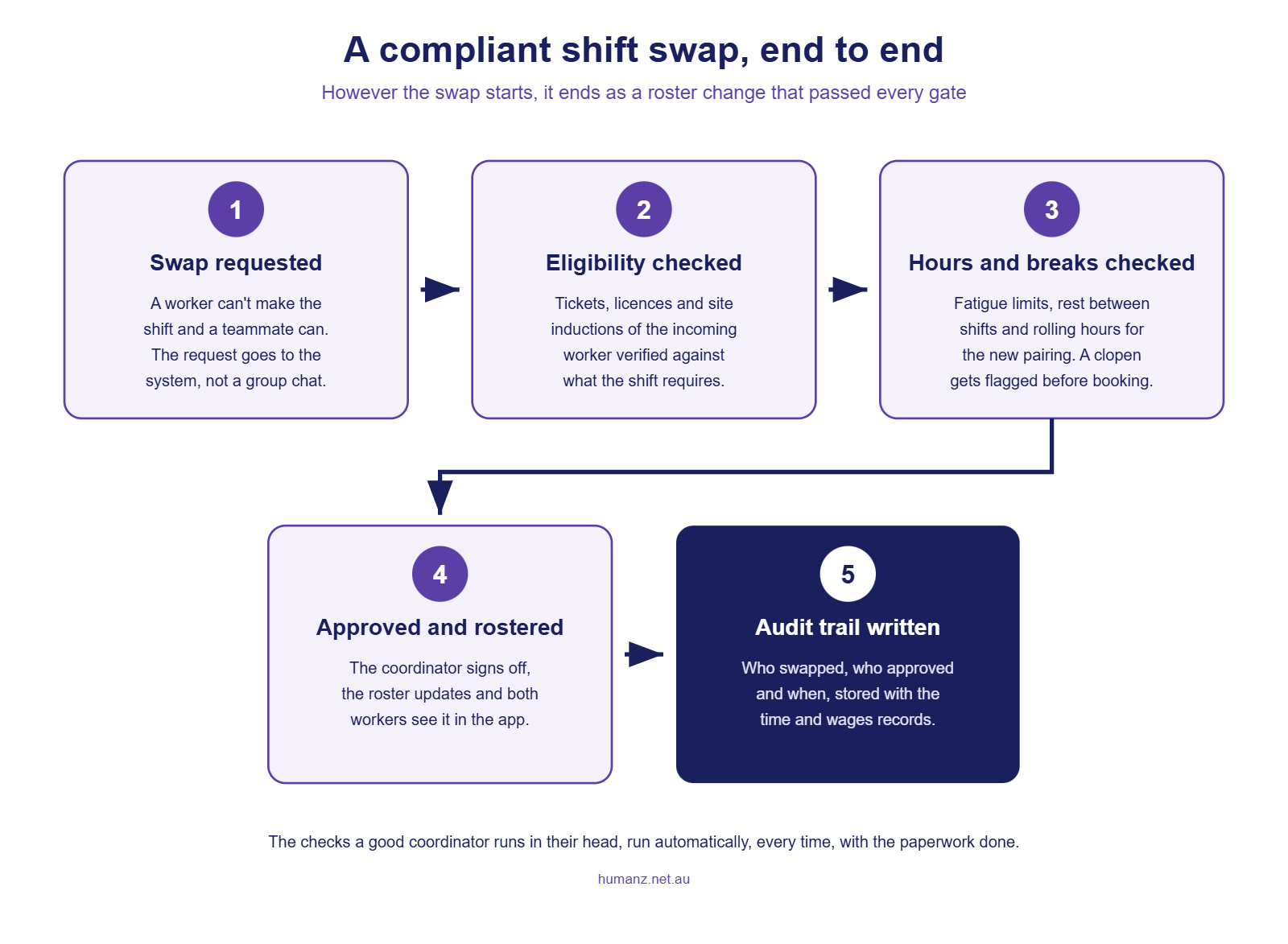
The request goes to the system, not around it. However the swap starts, it becomes a request against the actual shift. In Humanz, coordinators can also push an open shift to eligible workers as a booking request, which turns “who can take Saturday?” into one-tap responses instead of a ring-around, the same machinery covered in our internal resource booking guide.
Eligibility is checked automatically. The incoming worker’s licences, tickets and site inductions are verified against what the shift requires, and workers without them aren’t bookable onto it. The gate does the checking, not the coordinator’s memory. (For how those credentials stay current, see qualification and induction tracking.)
Hours and breaks are checked for the new pairing. The swap recalculates fatigue and break compliance for the incoming worker: rest since their last shift, consecutive days, rolling hour totals, and any layered client or site fatigue policy. That recalculation is exactly the job of a fatigue rule engine sitting under the roster. A clopen or a broken 10-hour gap gets flagged before the booking confirms, not discovered on the payslip. Safe Work Australia’s fatigue guidance treats these hour patterns as foreseeable risk, which makes “we didn’t know about the swap” a poor defence.
A coordinator approves, and the roster updates. The coordinator sees who’s in, who’s out and what the checks found, then signs off. Both workers see the updated roster in the app, with confirmation tracked, which closes the “I thought you had it” gap that produces no-shows. The same visibility logic that kills no-shows in real-time rostering applies doubly to swapped shifts, because that’s where assumptions creep in.
The audit trail writes itself. Who requested, who accepted, who approved, when, and what the checks showed, stored against the shift beside the timesheet it will prefill.
The checks that matter most under Australian rules
Three compliance layers should sit under every swap, and they’re the ones auditors ask about.
Minimum breaks between shifts. Most modern awards specify a minimum gap between rostered shifts (commonly 10 or 12 hours), with penalty consequences when it’s broken. Swaps are the classic way breaks get broken accidentally, because each shift looked fine when originally rostered.
Cumulative hours and fatigue. Consecutive days, night rotations and rolling 7-to-28-day hour caps, especially where client or site fatigue policies apply on top of the award. A swap that’s legal in isolation can still push a worker over a fatigue threshold, and platforms that treat fatigue as a rostering gate catch this at the moment it can still be fixed.
Qualifications and site access. The incoming worker must hold what the shift requires, including site-specific inductions that don’t transfer between sites. This is the check with the highest stakes and the one group chats are structurally incapable of running.
Run your own roster against hour and break limits with the free fatigue hours checker to see how close your current patterns sit to the line before swaps add noise.
What to look for in a shift swap app
Whether a vendor calls it a shift swap app, shift swapping software or just a feature of the roster, the checklist is the same, and every item on it is something a group chat can’t do.
- Eligibility checks on the incoming worker. The app knows what the shift requires (licence, ticket, site induction) and what each worker holds, and won’t book a mismatch. If all it checks is that a human is free, it’s a messaging tool with a calendar attached.
- Break and fatigue checks on the new pairing, recalculated for the swap and flagged before approval, not reported afterwards.
- Coordinator approval with the results in front of them. Automating the approval away entirely removes the one pair of eyes that knows the site.
- Push notifications and one-tap responses, so the request lands on a phone and everyone sees the result the moment it’s approved.
- An audit trail stored against the shift, so the “who worked Saturday?” question months later is a lookup, not a reconstruction from texts.
- Subbies on the same roster. Blended crews swap across the payroll boundary all the time; if subcontractors live in a different system, half your swaps are invisible to every check above.
Because every swap lands in the roster, timesheets prefill correctly, payroll pays the person who actually worked, and the planned-versus-worked reporting stays honest.
Getting crews off the group chat
The technology is the easy half. The habit change deserves a plan of its own, and three moves do most of the work.
Make the app the only door that opens. The policy line is one sentence: a swap isn’t a swap until it’s in the system. Supervisors hold that line for the first month by declining to honour chat-arranged changes, which feels harsh exactly once per crew.
Make the compliant path the fastest path. If requesting a swap in the app takes ten seconds and getting a text swap honoured takes a supervisor conversation, the app wins on laziness alone. This is where one-tap booking responses and push notifications matter more than any policy document.
Close the loop visibly. When workers see the roster update in their pocket the moment a swap is approved, trust in the system compounds. The fastest way to send crews back to the group chat is a system where changes take a day to appear.
Most businesses find the transition takes a few weeks, and the leading indicator is simple: supervisors stop being surprised by who turns up.
Frequently asked questions
What is a shift swap?
A shift swap is a worker-to-worker trade of a rostered shift: one worker hands over a shift they own and a workmate takes it, as a straight exchange or a one-way handover. It differs from an open shift, which a coordinator broadcasts to every eligible worker, and from cover, which is the office finding a replacement after a sick call. The incoming worker still needs the tickets and site induction the shift requires and the minimum break their award sets, and the swap must show in the time and wages record.
How do I swap a shift with a workmate?
Agree the swap with your workmate, check that you both hold what the shift needs and that the rest gap between your shifts fits, then put the request through the app or to the coordinator in writing. Nothing changes until the coordinator approves it, so the original name stays responsible until then. Once approved, check the updated roster shows the new names, because that is what payroll and the site record follow.
What is shift swap software?
It’s rostering functionality that lets shifts change hands through the system instead of around it. A swap or open shift becomes a request, the software checks the incoming worker’s qualifications, hours and breaks, a coordinator approves, and the roster, notifications and audit trail all update automatically.
Can software stop a swap that would breach an award’s break rules?
Yes. Because the system knows both workers’ rostered and worked hours, it can flag a swap that would break the minimum gap between shifts, exceed consecutive-day limits or push a rolling-hours cap before the booking is confirmed. The warning appears at approval time, when the swap can still be declined or adjusted.
Do shift swaps need to be recorded for Fair Work compliance?
Yes. Time and wages records must reflect who actually worked, and they must be kept for seven years. A swap that lives only in a group chat leaves the official record wrong on both counts. And the rules get enforced. The Fair Work Ombudsman issued 743 infringement notices for record-keeping or pay slip breaches in 2024-25, with $838,000 in penalties paid. Routing swaps through the roster keeps records accurate and produces an audit trail of who approved the change and when.
What’s the difference between a shift swap and an open shift?
A swap is worker-to-worker: someone can’t make a shift they own and a specific teammate takes it. An open shift is coordinator-to-many: a gap is broadcast to every eligible worker at once, first-in or coordinator’s pick. A good platform runs both through the same qualification, hours and break gates, so the only real difference is who starts the conversation.
Can workers swap shifts without a coordinator being involved?
The healthiest model keeps approval with a coordinator while automating everything around it. Workers initiate and accept in the app, the system runs the eligibility, hours and break checks, and the coordinator gets a one-look approval with the results in front of them. That preserves oversight without the ring-around.
How do you get crews off group-chat swaps?
Make the app the only door that opens, and the fastest one. The policy is one sentence, a swap isn’t a swap until it’s in the system, and supervisors hold that line by declining chat-arranged changes for the first month. If requesting a swap takes ten seconds in the app, it wins on laziness alone. Most crews make the transition in a few weeks.
What is a clopen shift?
A clopen is a closing shift followed by an opening shift the next morning, with too little rest in between. It commonly breaches the minimum break requirements in modern awards and is a known fatigue risk. Swap approvals are where clopens usually sneak in, which is why the break check has to run on the new pairing rather than the original roster.
Related articles
Ready to see Humanz on your own roster?
Free 30-minute walkthrough, we'll use your real crews, sites and shift patterns.